

Scientific evidence
OrthoGain evidence: exosome NTA, growth factor ELISA and safety
At OrthoGain, scientific transparency is an important part of product communication. We focus on measurable analytical characterisation of the final preparation.
01 · Nanoparticle Tracking Analysis
Particle concentration & size
NTA is an analytical technique used to evaluate nanoparticles through their Brownian motion and light-scattering behaviour. It provides information about particle concentration, particle size distribution and the distribution profile of detected particles.
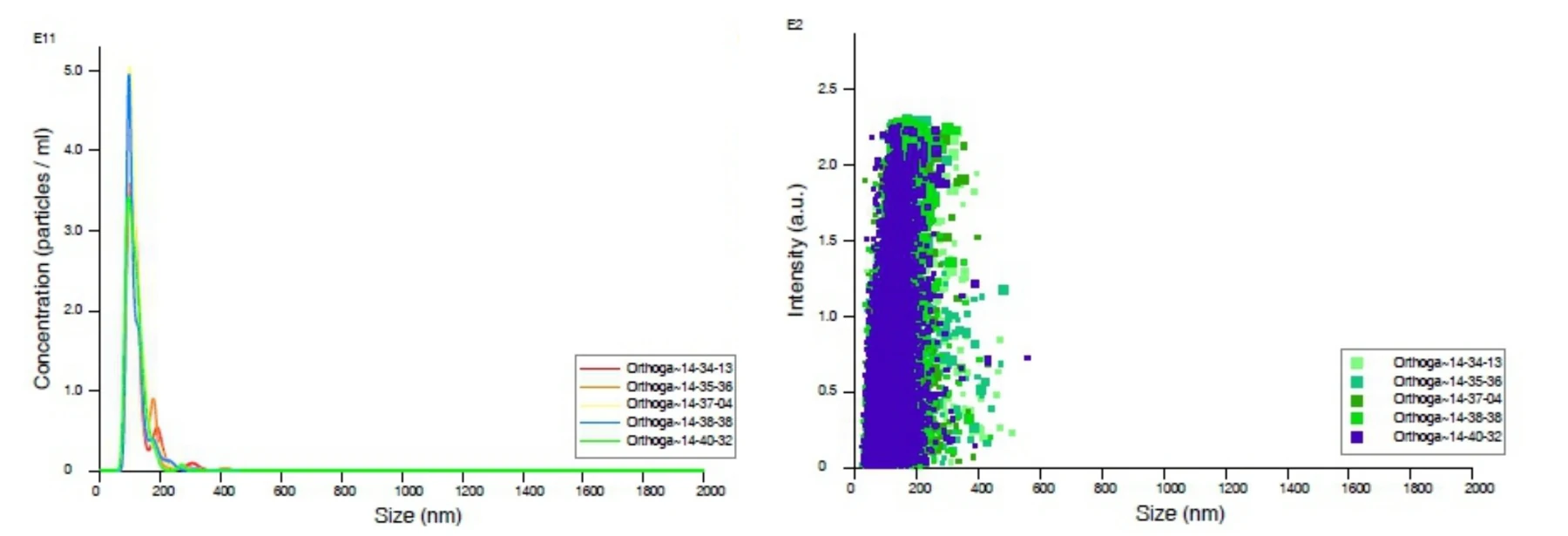
Particle concentration
Reported nanoparticle concentration in the final preparation.
Size distribution
Of detected particles between 30–150 nm.
Quantified by ELISA
PDGF, VEGF, TGF-β, EGF and bFGF, alongside the particle data.
Note: NTA provides information about the nanoparticle population. It does not independently establish exosome identity or purity. The full NTA report is available to healthcare professionals on request.
02 · Enzyme-Linked Immunosorbent Assay
Growth factor concentration
ELISA quantifies selected proteins and growth factors in a biological sample. OrthoGain’s assessment covers PDGF, VEGF, TGF-β, EGF and bFGF — information about their concentration in the final preparation.
PDGF · axis 0–100,000 pg/ml
VEGF, bFGF, TGF-β, EGF · axis 0–4,000 pg/ml
View the data as a table
| Growth factor | Concentration | Unit | Associated role |
|---|---|---|---|
| PDGF | 99,443.75 | pg/ml | Fibroblast recruitment, connective tissue repair |
| VEGF | 3,899 | pg/ml | Angiogenesis, tissue vascularisation |
| bFGF | 2,793 | pg/ml | Cell proliferation and migration |
| TGF-β | 1,732.50 | pg/ml | Extracellular matrix, collagen synthesis |
| EGF | 550 | pg/ml | Cellular proliferation, epithelial repair |
03 · Scientific transparency
Verifiable analytical documentation
Analytical characterisation
We believe scientific information should be supported by verifiable analytical documentation. Available for professional evaluation:
Clinical evidence
Analytical characterisation and clinical efficacy are separate areas of evidence. Clinical benefits for individual orthopaedic indications should be established through appropriately designed clinical studies.
Our commitment: transparent scientific communication, responsible clinical positioning and continued evaluation of regenerative technologies.
Safety
Patient-specific. Autologous. Professionally prepared.
OrthoGain is designed as an autologous preparation system using blood-derived material from the individual patient.
Autologous source
The preparation uses the patient’s own blood-derived components, avoiding the use of donor-derived biological material.
Single-patient use
The kit is intended for individual patient preparation. Disposable components must not be reused or shared between patients.
Controlled preparation
The preparation process follows a defined sequence of collection, separation, processing and filtration.
Professional administration
To be handled and administered by qualified healthcare professionals following aseptic technique.
Patient assessment
Appropriate patient selection, medical history assessment and clinical evaluation are essential before any procedure.
Precautions & adverse events
As with blood collection and injection procedures, local pain, tenderness, bruising, swelling or other reactions may occur.
Our safety commitment: patient safety, professional training, proper handling and transparent documentation remain central to the OrthoGain approach. For healthcare professionals: request the technical documentation before clinical use. Report any suspected adverse event to info@orthogain.in.
For orthopaedic surgeons, sports medicine specialists, hospitals & healthcare professionals
Innovation that supports regeneration.
Advancing biological science. Exploring new possibilities. Supporting better healthcare.